Astrophotography
Build notes first published by amateur station AC8GY and kept here as an archived project write-up. First-person passages are the original builder's. This site is not run by AC8GY. See the disclaimer before building.
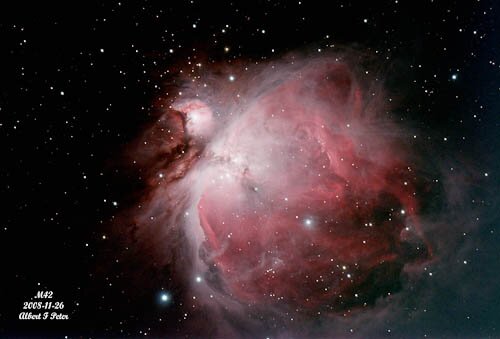
M42 The Orion Nebula
 |
 |
 |
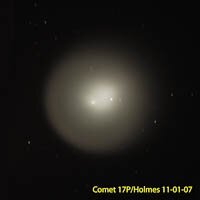 |
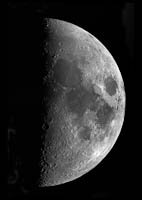
| Presentation | Lunar Eclipse Movie | Messier Image Gallery | Comets Image Gallery |
 |
 |
 |
 |
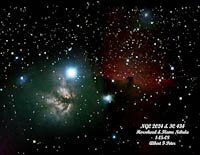
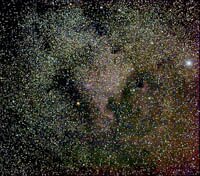
| Lunar Gallery | Other DSOs | Conjunctions & Star Fields | Sun & Planets |
Digital Astrophotograpgy PDF Presentation (large)
Amateur Astronomy
For as long as man has gazed up at the skies there has been a fascination with the stars. In the early days of astronomy, there was no distinction between amateurs and professionals. Today, astronomy is a very complex and technical pursuit, yet many of us are compelled to investigate the wonders of the Universe. Because there is so much to the science of astronomy, amateurs can pursue a varied set of courses to their end. This section is about the far distant “fuzzies” in the sky, usually called DSOs or Deep Sky Objects: galaxies, star clusters and nebulae, observed by photographing them.
Not having access to the clear dark skies of a mountain top where the major observatories are located, amateurs around here must work around our light-polluted skies. This is accomplished using telescopes that are modest in size, but which are augmented by modern electronic imagers. It is these digital “cameras” that make it possible to take long exposures from our backyards, resulting in images only available from major instruments just 20 years ago. There is an enormous satisfaction in imaging a galaxy, cluster or nebula whose light started its journey millions and millions of years ago.
The instruments we use vary in size from ordinary digital cameras with wide angle lenses to large apertures up to 20” or more in diameter. Many visual observers use the simplest of mounts with no tracking or electronic aids.Imagers for DSOs have more stringent requirements. Mounts that track the movements of the stars and include “goto” computers, which can point the telescope to any of thousands of stars, planets, and DSOs are commonly used. The imaging electronics may be a simple point-and-shoot digital camera, a regular DSLR (digital single lens reflex), or a special cooled CCD camera that has very low noise and high sensitivity.
The images of DSOs are usually created by taking many relatively short exposures ranging from 30 seconds to ten or more minutes. Overall exposures of 20 to 30 minutes up to several hours are created by combining multiple images using specialized computer programs. These techniques reduce noise and light pollution effects and reduce the necessity for mounts that can keep an image accurately centered for several hours. All this technology has become available to amateurs over the past 15 to 20 years.
The images here came from a typical progression of amateur equipment: a small refractor on an alt/az mount, a home-ground 6” mirror for a Newtonian, an 8” SCT (Schmidt-Cassegrain) on a tracking equatorial mount with an object-finding computer, and finally a 9.25” SCT on a “goto” mount plus a shorter focal length 5” refractor. Most of the images in this exhibit were taken with the last two, with active tracking for very long, computer-controlled exposures.
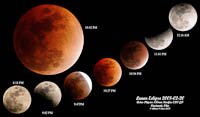
Many long nights have been dedicated to acquiring the images and lots more hours have been spent in processing the many sub-frames into the final images shown. The resulting images certainly do not rival those captured by Hubble or any of the large telescopes professionals use, but the personalization of the process yields an intimate connection to astronomy and the objects imaged that no textbook can supply. Seeing and imaging the real thing is the best way to gain an appreciation for the extent and majesty of this Universe in which we live. There is nothing like having experienced a Lunar eclipse in 13 degree weather, February 2008, to give one an appreciation for the science of astronomy.
Astrophotography is a pursuit of perfection: a better imaging camera brings out the fainter parts of a DSO, and the 110 Messier objects alone make a long-term imaging list. There are more than enough objects out there to last a lifetime. The images here show what a backyard setup can do, and may help another amateur see a first DSO appear on the computer screen. Return to top